

Latest Version
Visit PageMore About :game
The game is designed for both newcomers and experienced Duelists. Beginners can learn the fundamentals through tutorials and Duel Strategy missions, while veteran players can build specialized decks and compete against Duelists around the world.
Master Duel supports cross-platform play and linked game data, allowing players to continue their experience across supported platforms. The game is free to play with optional in-game purchases.
What Makes Yu-Gi-Oh! Master Duel Different?
Master Duel is built around the modern Yu-Gi-Oh! card game rather than a simplified mobile interpretation. Its enormous card pool gives players considerable freedom when creating decks and developing different strategies.
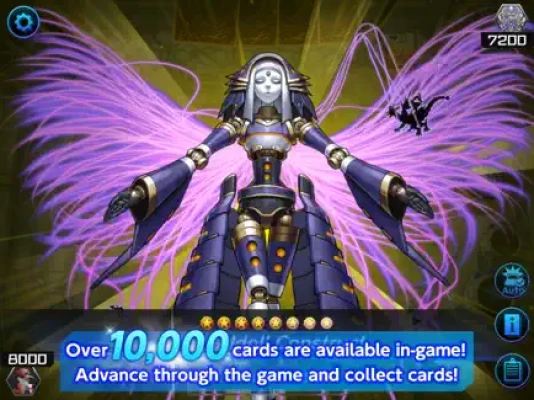
The game includes more than 10,000 cards, Solo Mode story content, online Duels, tournaments and special events. Card crafting also allows unwanted cards to be dismantled and used toward creating cards that better fit your decks.
For players who enjoy competitive card games, the biggest attraction is the depth. A single duel can involve careful resource management, chained effects, combo preparation, defensive interruptions and several different Summoning mechanics.
Yu-Gi-Oh! Master Duel Gameplay
The basic objective is simple: reduce your opponent's Life Points to zero while protecting your own strategy.
The difficult part is deciding how and when to use your cards.
A successful Duelist needs to understand:
Monster effects
Spell and Trap cards
Normal and Special Summons
Synchro Summoning
Xyz Summoning
Pendulum Summoning
Link Summoning
Chain interactions
Card advantage
Resource management
Board control
Timing and interruption
Master Duel's Solo Mode introduces these mechanics gradually, including dedicated lessons for Synchro, Xyz, Pendulum and Link Summoning.
Solo Mode Guide
Solo Mode is one of the best places to start if you are new to Yu-Gi-Oh! or returning after a long break.
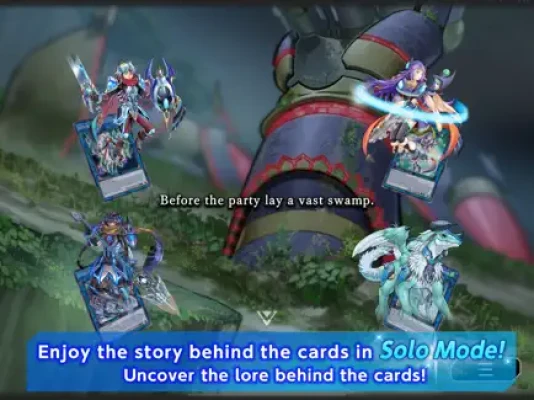
The tutorials explain the fundamental card types and basic rules before introducing more advanced Summoning mechanics. Other Solo Mode campaigns also explore the stories and themes behind different card archetypes.
Best Way to Approach Solo Mode
Start with the basic tutorials rather than immediately jumping into competitive matches.
Pay attention to the following:
Learn the difference between card effects and battle actions.
Understand how Chains work.
Practice Special Summoning.
Learn when you can activate Quick Effects.
Study the Extra Deck Summoning methods.
Experiment with the provided Loaner Decks.
Complete Solo Mode objectives to collect useful rewards.
Solo Mode is particularly valuable because it allows you to learn mechanics without the pressure of a ranked opponent.
Deck Building Guide
Deck building is one of the most important skills in Yu-Gi-Oh! Master Duel.
A strong deck is not simply a collection of powerful cards. The cards need to work together toward a clear strategy.
Before creating a deck, ask yourself:
What is this deck trying to accomplish?
It could focus on aggressive attacks, controlling the opponent's board, generating powerful combinations, summoning a particular boss monster or slowly gaining an advantage through repeated effects.
Keep Your Strategy Focused
Avoid filling a deck with unrelated cards simply because each card looks powerful.
A focused deck usually performs more consistently because its opening hands are more likely to contain cards that work together.
Learn Your Key Cards
Identify the cards that start your main combos and the cards that finish them.
For every important card, understand:
What it does
What activates its effect
What it searches for
What it can summon
What can stop it
Whether it should be used immediately or saved
Knowing your own cards is often more important than memorizing hundreds of cards from the entire game.
Card Crafting Strategy
Master Duel includes a card crafting system that lets players dismantle unwanted cards and use resources to generate cards they need.
This makes resource management extremely important for free-to-play players.
Do Not Spend Crafting Resources Too Quickly
Before crafting an expensive card, decide which deck you want to build.
A common mistake is spending resources on several unrelated decks and ending up with multiple incomplete collections.
A better approach is:
Choose one main deck.
Build its essential cards first.
Test the deck.
Identify weaknesses.
Add important support cards.
Only then begin investing heavily in another deck.
This approach gives you a more reliable competitive deck without wasting valuable resources.
Beginner Duel Strategy
Your first few matches can feel overwhelming because experienced players may perform several actions before you get an opportunity to respond.
Don't worry about memorizing every possible combination.
Instead, concentrate on learning the fundamentals.
1. Think Before Activating an Effect
Not every effect should be activated immediately.
Sometimes the strongest move is to wait.
An opponent may have several cards available, and using your interruption too early can allow them to continue their combo.
2. Learn to Recognize Combo Starters
Many decks depend on specific cards to begin their main sequence.
If you understand which card starts an opponent's strategy, you can make better decisions about where to interrupt.
3. Protect Your Important Cards
Do not spend every defensive card simply because you can activate it.
Save key interruptions for situations where they can significantly reduce your opponent's options.
4. Watch Your Resources
Every card in your hand has potential value.
Think about what you may need one or two turns later before using everything immediately.
5. Read Cards Carefully
Yu-Gi-Oh! is a game where wording matters.
Pay attention to phrases such as:
"Target"
"Destroy"
"Send to the GY"
"Banish"
"Once per turn"
"If"
"When"
"Quick Effect"
Small differences in wording can completely change how an interaction works.
Advanced Duel Strategy
Once you understand the basics, your focus should shift from simply making plays to making efficient plays.
Generate Card Advantage
Card advantage means getting more useful value from your cards than your opponent gets from theirs.
For example, a card that searches another card can effectively give you additional access to your strategy without requiring you to draw the exact card naturally.
Force Your Opponent to Respond
Strong players often make their opponent react to their plays.
Instead of revealing your entire strategy immediately, consider which action is most likely to force a defensive response.
Once the opponent uses an important interruption, your remaining cards may become much easier to resolve.
Understand Board Breaking
Sometimes you will go second against an established board.
Your goal is not always to destroy everything immediately.
Instead, identify:
Which monster is the biggest threat?
Which effect can stop your next play?
Which card provides the opponent with additional resources?
Which interruption should be baited first?
What cards do you need to keep for the final attack?
Breaking a board efficiently is often about removing the right threats rather than removing every card.
Going First vs Going Second
Your strategy can change dramatically depending on whether you take the first turn or the second turn.
Going First
When going first, your priorities are usually:
Establish your main board.
Set up defensive interruptions.
Prepare follow-up plays.
Keep resources available for the next turn.
Avoid unnecessary commitments.
A strong first turn should leave you with both a threatening board and a way to continue playing afterward.
Going Second
Going second gives you information about the opponent's established board before making your main plays.
Your priorities become:
Identify dangerous effects.
Force interruptions.
Break the opponent's board.
Establish your own field.
Look for a safe path toward victory.
Do not automatically surrender simply because your opponent has a powerful opening board. Many decks are designed specifically to dismantle established fields.
Summoning Mechanics Explained
Synchro Summoning
Synchro Summoning generally requires a Tuner and other monsters whose Levels meet the required total.
The important skill is planning your Levels before committing your monsters.
Xyz Summoning
Xyz Monsters are generally summoned by using monsters with the same Level.
The materials placed underneath an Xyz Monster can become resources for its effects, making material management extremely important.
Pendulum Summoning
Pendulum strategies revolve around Pendulum Scales and can allow multiple monsters to be summoned under the appropriate conditions.
The mechanic can be powerful but requires careful understanding of scales and available zones.
Link Summoning
Link Monsters use monsters on your field as materials and introduce another layer of positioning and Extra Deck strategy.
Learning which monsters can be used as Link Materials is essential when playing Link-focused decks.
Master Duel's built-in Duel Strategy content specifically introduces these four major Extra Deck and advanced Summoning methods.
How to Improve at Ranked Duels
Ranked play is where your decision-making gets tested against real opponents.
Don't judge your skill entirely by your win rate.
After every difficult loss, ask:
Did I misunderstand an effect?
Did I use an interruption too early?
Did I choose the wrong combo line?
Did I waste resources?
Did I fail to anticipate my opponent's next move?
Did I build my deck inconsistently?
Could I have played around a known interruption?
Recording or reviewing difficult games can help you identify repeated mistakes.
How to Practice Efficiently
A good practice routine can make a major difference.
Practice Routine
Step 1: Learn your deck's main combo.
Step 2: Learn an alternative combo when your starter is interrupted.
Step 3: Practice opening-hand scenarios.
Step 4: Learn your opponent's common interruptions.
Step 5: Practice playing from weak positions.
Step 6: Review your losses instead of immediately starting another match.
The goal is not simply to memorize one perfect sequence. You want to understand how your deck behaves when the opponent disrupts your plan.
Tips for New Players
Finish the tutorials before focusing heavily on ranked play.
Spend your resources carefully.
Build one strong deck before collecting many incomplete decks.
Read every important card effect.
Learn your deck's main combo and backup lines.
Don't activate every effect immediately.
Save important interruptions for high-value moments.
Use Solo Mode to practice unfamiliar mechanics.
Study successful deck lists for ideas.
Learn why a card is included rather than copying a deck blindly.
Review your losses and identify the decision that changed the duel.
Keep improving your understanding of Chains and timing.
Common Beginner Mistakes
Building a Random 40-Card Deck
Adding cards because they are individually powerful does not guarantee a strong deck.
Consistency matters.
Spending All Resources on Multiple Decks
Trying to build five decks at once can leave every deck unfinished.
Concentrate your resources until you have a reliable primary deck.
Using Removal Too Early
Removing the first monster you dislike may not be the best play.
Sometimes the real threat is the card behind it.
Ignoring the Graveyard
The Graveyard is not simply a place where cards disappear.
Many modern strategies use it as an additional resource.
Always consider what your opponent can recover or activate from the Graveyard.
Playing on Autopilot
Yu-Gi-Oh! rewards players who adapt.
Following the same combo without considering the opponent's cards can turn a winning position into a loss.
Yu-Gi-Oh! Master Duel Features
Master Duel offers a large collection of features for both casual and competitive players:
Competitive online Duels
Ranked gameplay
Solo Mode
Tutorials
Duel Strategy missions
Special events
Tournament-style formats
Extensive deck-building tools
Card crafting
Thousands of collectible cards
Cross-platform play
Cross-platform progression
Deck customization
Duel Fields
Card Protectors
Mate companions
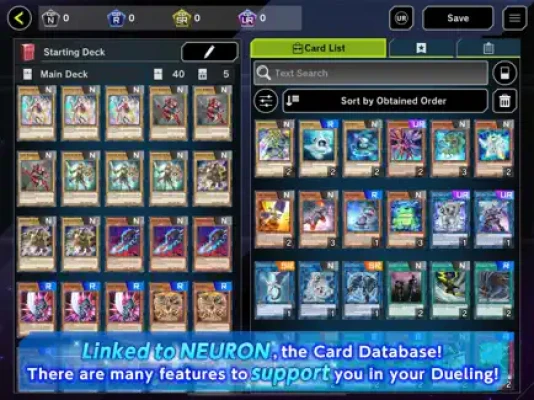
Integration with Yu-Gi-Oh! Neuron
The official game information confirms cross-platform play and linked game data, while the App Store listing highlights online competition, events, Solo Mode, card collecting and deck building.
Yu-Gi-Oh! Neuron and Deck Research
The Yu-Gi-Oh! Neuron companion app can be useful when improving your deck-building skills.
The Master Duel App Store listing notes that players can use Neuron to view decklists from Duelists around the world and test opening hands through its sample draw feature.
This is particularly useful when you want to understand how experienced players construct their decks and how consistently a deck reaches its preferred opening setup.
Graphics, Sound and Presentation
Master Duel focuses on presenting the card game as a polished digital experience rather than simply displaying static cards.
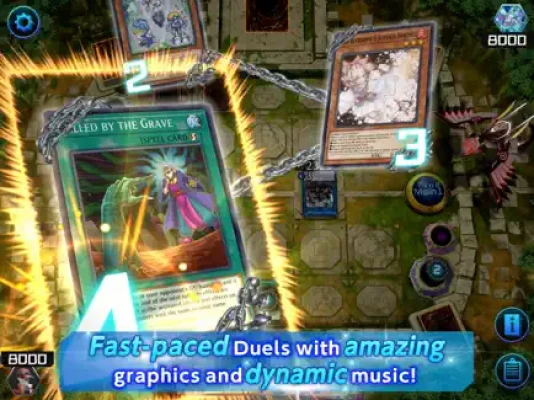
Duels feature animated card effects, visual summon sequences, music and detailed environments. Konami describes the game as a fully digital version of the Yu-Gi-Oh! TCG experience with highly rendered Duels and extensive audiovisual presentation.
Platforms and Compatibility
Yu-Gi-Oh! Master Duel is available across multiple platforms, including iOS, Android, PlayStation, Xbox, Nintendo Switch and PC platforms.
The iOS version requires iOS 15 or later according to the current App Store listing and supports iPhone and iPad devices.
Cross-platform functionality allows players to compete against Duelists using other supported systems and link their game data across platforms.
Is Yu-Gi-Oh! Master Duel Free to Play?
Yes. Yu-Gi-Oh! Master Duel is free to play, with optional in-game purchases.
Players can collect cards and develop decks through normal gameplay, while optional purchases provide additional access to the game's virtual currency and other items. The App Store listing also notes that the game contains randomized virtual-item purchases.
Is Yu-Gi-Oh! Master Duel Good for Beginners?
Yes, but beginners should expect a learning curve.
The basic rules are relatively straightforward, but modern Yu-Gi-Oh! contains a huge number of cards and interactions. The best approach is to learn gradually.
Start with Solo Mode, understand the major Summoning methods, learn one deck thoroughly and then begin testing yourself against other players.
Trying to memorize the entire card pool immediately is unnecessary.
Is Yu-Gi-Oh! Master Duel Worth Playing?
Yu-Gi-Oh! Master Duel is a strong choice for players who enjoy strategic card games, competitive PvP and deep deck customization.
Its biggest strength is the sheer amount of strategic freedom. There are countless combinations to discover, different deck styles to learn and a constantly evolving competitive environment.
The game can be intimidating at first, but once you understand its core mechanics, the depth becomes one of its biggest advantages.
Pros and Cons
Pros
Deep and strategic card gameplay
Huge card collection
Strong deck-building system
Solo Mode for learning and story content
Competitive online Duels
Multiple Summoning mechanics
Cross-platform play
Cross-platform progression
Card crafting system
Regular events and additional content
Excellent presentation and animations
Cons
Steep learning curve for new players
Large card pool can feel overwhelming
Competitive matches can become very fast
Understanding modern deck interactions takes time
Optional purchases are available
Some cards and strategies require significant investment of resources
Frequently Asked Questions
What is Yu-Gi-Oh! Master Duel?
Yu-Gi-Oh! Master Duel is a digital version of the competitive Yu-Gi-Oh! Trading Card Game featuring online Duels, Solo Mode, deck building, card collecting, events and thousands of cards.
Can beginners play Yu-Gi-Oh! Master Duel?
Yes. The game includes tutorials and Duel Strategy missions designed to teach fundamental mechanics and advanced Summoning methods.
Does Master Duel have Solo Mode?
Yes. Solo Mode contains tutorials, strategy lessons and story-focused campaigns based around different Yu-Gi-Oh! card themes.
How many cards are in Master Duel?
The game features more than 10,000 cards, although availability of particular cards can depend on the game's content and events.
Can I play Master Duel against other platforms?
Yes. Master Duel supports cross-platform online play and linked game data across supported platforms.
Can I craft cards?
Yes. Master Duel includes card crafting, allowing players to dismantle unwanted cards and use crafting resources toward obtaining other cards.
Is Master Duel free?
Yes. The game is free to play with optional in-game purchases.
What is the best deck in Master Duel?
There is no permanent single best deck. Competitive deck strength changes as the card pool, Forbidden & Limited List, events and competitive environment evolve.
The better approach is to choose a strategy that matches your preferred playstyle and learn it thoroughly.
What should beginners do first?
Complete the tutorials and Solo Mode lessons, learn one deck, practice its main combos and gradually move into online Duels.
Final Verdict
Yu-Gi-Oh! Master Duel is much more than a simple digital card game. It is a detailed competitive platform where deck construction, timing, card knowledge and decision-making all matter.
For newcomers, the sheer number of cards and effects can seem intimidating. However, the game's tutorials and Solo Mode provide a useful starting point, while experienced players have an enormous amount of strategic depth to explore.
If you enjoy collectible card games and want a serious digital Yu-Gi-Oh! experience, Master Duel offers an impressive combination of competitive Duels, deck customization, Solo Mode content and cross-platform play.
Rate the Game
User Reviews




Popular Games



















 Android
 iOS
iOS Windows
 Xbox
Xbox